Chess, move by move.
How to set up the board, how each piece moves and captures, castling, en passant and promotion, check, checkmate and stalemate, how to write moves down, and where the game came from. Every rule is checked against the FIDE Laws of Chess or Britannica, and every one links to its source.
The short version
Chess is one of the oldest and most popular board games, played by two opponents on a checkered board. Britannica: chess White makes the first move, then the players take turns. FIDE Laws of Chess
The aim is to put the other king under attack so that the other player has no legal move. FIDE Laws of Chess
The game is won by the player who checkmates the other king. FIDE Laws of Chess If the player to move has no legal move and their king is not in check, the game is a draw. This is called stalemate. FIDE Laws of Chess
Chess first appeared in India in about the 6th century CE, as a game called chaturanga. Britannica: chess By the 10th century it had spread from Asia to the Middle East and Europe. Britannica: chess
Start exploring
Where the facts come from
The rules come from the FIDE Laws of Chess, the rules of the international chess federation. The history, the starting squares and the extra examples come from Britannica’s chess article. Where the two sources say something in different ways, we give each one.
And how old are the Lewis chess pieces?
Britannica’s main text says the Vikings are believed responsible for 78 walrus-ivory chess pieces found on the Isle of Lewis in 1831, dating from the 11th or 12th century. Britannica: chess Britannica’s picture caption says the Lewis pieces were carved from walrus tusk ivory and whale teeth, are thought to be Norwegian, and date from the late 12th or early 13th century. Britannica: chess
Two dates in one article: see when sources disagree.
Enjoying the chess guide? Help keep the lights on.
This site is hand-built, fact-checked and free to read. If a rule, a game or one of Useless’s notes helped, a little support keeps it going and helps the network grow.
Chess printables
Fact-checked PDFs in A4 and US Letter, for young beginners, puzzle solvers, families, new players and the grown-ups teaching them.
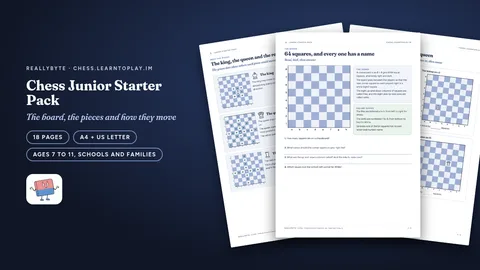
Chess Junior Starter Pack
Ages 7 to 11, schools and families
The board and its squares, setting up, meet the six pieces, where-can-it-go worksheets, a true-or-false quiz, a crossword where every answer is a real fact, a word search, a certificate and a full answer key
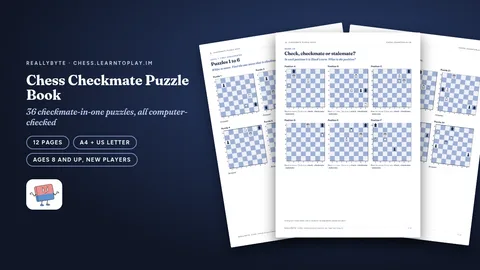
Chess Checkmate Puzzle Book
Ages 8 and up, new players
Check, checkmate or stalemate? sorting, then 36 checkmate-in-one puzzles in three levels, every one checked by computer to have exactly one answer, with full answers
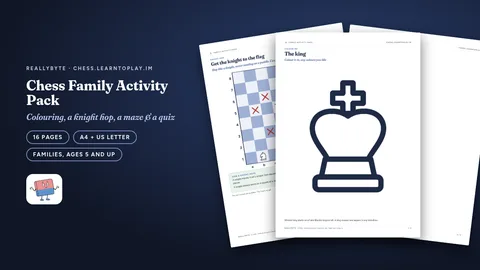
Chess Family Activity Pack
Families, ages 5 and up
Six piece colouring pages, a knight-hop puzzle, a pawn maze, design your own chess set, a match-the-piece game and a 20-question family quiz to do together, with answers
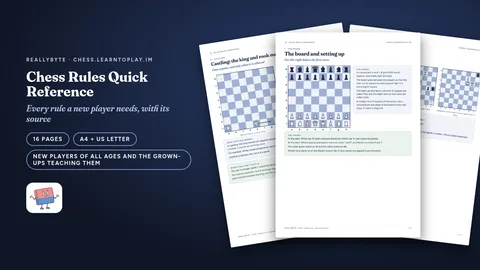
Chess Rules Quick Reference
New players of all ages and the grown-ups teaching them
The board, set-up, how each piece moves and captures, castling, en passant and promotion, check, checkmate, stalemate and draws, touch-move and table manners, piece values and how to write moves down, each rule with its source
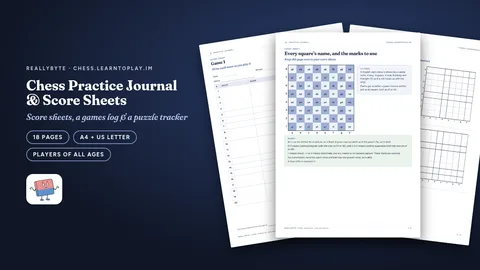
Chess Practice Journal & Score Sheets
Players of all ages
How to write moves down, a notation cheat sheet, 8 score sheets, a games log, a puzzles tracker, position sketch pages, a results tally and goals
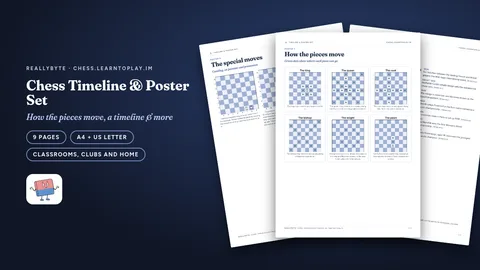
Chess Timeline & Poster Set
Classrooms, clubs and home
Six poster pages: how the pieces move, setting up the board, every square’s name, the special moves, a timeline from the 6th century to 2024, and the pieces in numbers
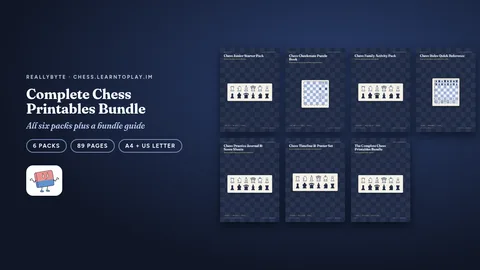 Best value
The Complete Chess Printables Bundle
All six packs plus a bundle guide, A4 and US Letter, in one download. $12.99 instead of $26.44 bought separately.